We perform an experiment which involves two masses m and M connected by a string which
we will consider to be massless. Mass m hangs over the edge of a table. The string passes over a pulley at the edge of the table and mass M sits on the table, such that it moves along the table without friction (See figure). The tension in the string is the force that the string exerts where it is connected to another object or to more string. It is generally true that the tension anywhere along the string is the same as the tension anywhere else in the string.
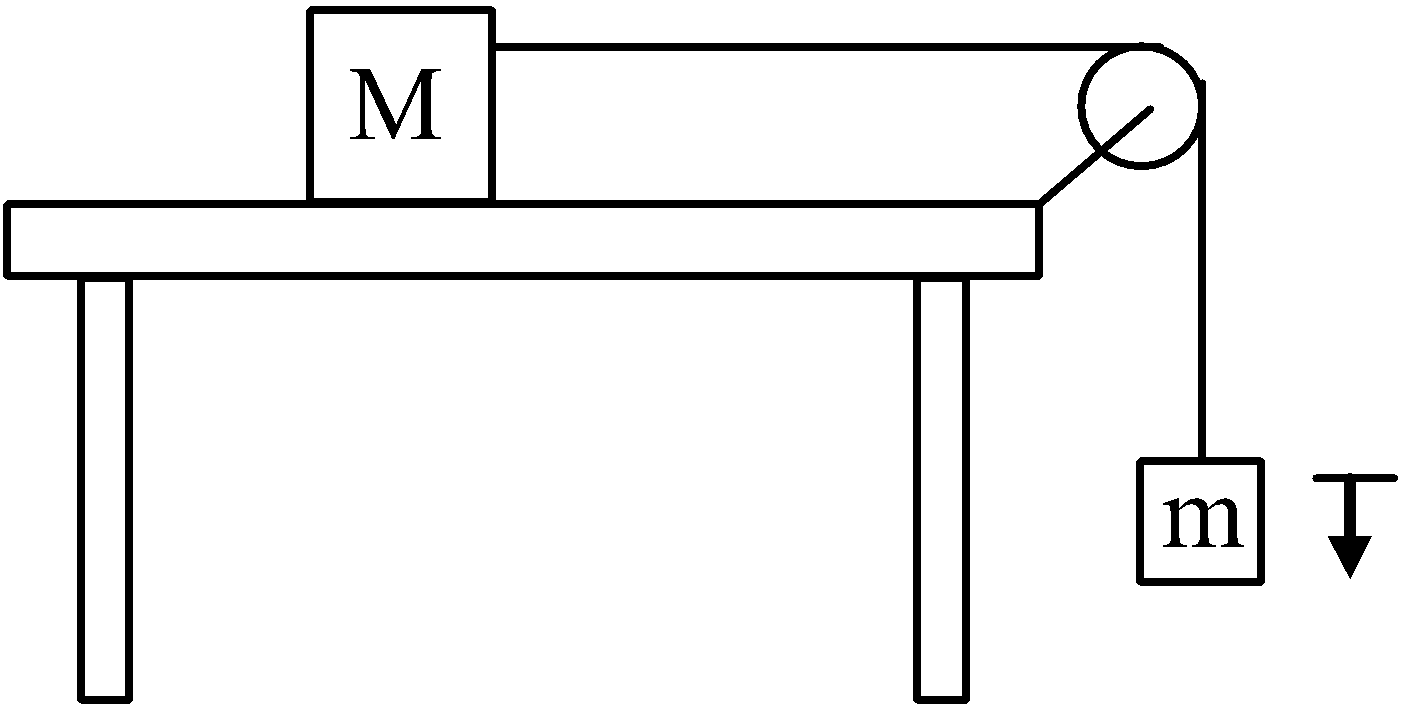
In this experiment the mass m is initially at rest and allowed to drop. Its position x is measured downward from its initial position. At various times, the position x and velocity v of mass m are measured and the results are recorded in the table which follows:
t(s) x(m) v(m/s)
0.0 0.00 0.0
0.2 0.01 0.1
0.4 0.04 0.2
0.6 0.09 0.3
(i) Which of the following is evidence that the acceleration is uniform?
Text Solution
Verified by ExpertsCHECK THE SOLUTION.
(i) : Choice A and B are irrelevant, and comparisons, such as those in choice C, are meaningless
if the units do not match. The correct choice is D. From the table we can see that equal jumps of time (for example, 0.2 s to 0.4 s) result in equal jumps of velocity (0.1 to 0.2 m/s). This is consistent with the statement that Δ v / Δ t is a constant, or that acceleration is constant.
(ii) : It seems as if acceleration would be a useful quantity to calculate, so let’s choose the interval from t = 0.0 to 0.2 second obtaining
a = Δ v/ Δ t
= (0.1 m/s – 0.0 m/s) / (0.2 s – 0.0 s)
= 0.5 m/s 2
Now we can look at the interval from t = 0.0 s to 0.9 s. We want to find Δ x and we have
Δ t = 0.9 sec, v 1 = 0.0 m/s and a = 0.5 m/s 2 . From this we calculate Δ x =  a( Δ t) 2
  0.20 m.
(iii) : The things touching mass M are the table and the string. It is true that the tension in the string is, in some sense, caused by mass m, but M does not know or care what the other end of the string is connected to. It only cares that there is a force due to a string which is directed to the right.
Prepare Smarter with CGP Edu
Get practice questions, solutions, and test series in one place.
Write a Review
Share your experience with this question and solution.
Commentary
Send your comment, doubt, correction, or feedback to admin.
Similar Questions
Explore conceptually related problems